Why I finally decided to build a Caterham Seven more than thirty years after my first drive in one…
A lifelong interest in things mechanical
I’ve always been interested in cars, motorcycles, aviation and perhaps more than anything, how mechanical things work. After leaving school in 1978 with A-levels in maths, physics and chemistry, I started a mechanical engineering degree. I soon realised that a career in engineering wasn’t for me and left during the first year but with no particular idea of what to do next.
I drifted into a sales career, then took a rather different direction when I applied to join the Royal Air Force as aircrew. To my surprise, I passed selection at RAF Biggin Hill and commenced initial officer training in November 1981. I was subsequently assessed as unlikely to reach the required standard and left the RAF in May 1982. That autumn, I began studying ophthalmic science at Glasgow College of Technology, qualifying as an optometrist in 1986. I subsequently spent the following years working as an optometrist and eventually became a partner director in a Specsavers Joint Venture practice in 1998, before my retirement in 2014.
Throughout all those changes of direction, my interest in machinery remained constant. I’ve ridden motorcycles since my late teens and have always enjoyed carrying out my own servicing, maintenance and repairs on both bikes and cars.
An aeroplane that never quite got built
Aviation was another longstanding interest that never quite went away. I learned to hang glide in 1997 and spent roughly ten years flying from winch-launch sites in Norfolk, as well as from the hills in the Peak District. Some of my most memorable flights were cross-country from Fransham to Weybourne beach in Norfolk.
In 2001, I bought a Europa composite aircraft kit, intending to build the aeroplane and gain my pilot’s licence. Unfortunately, the hours I was putting into running an opticians’ practice left precious little time for building. Although I gained my PPL, I eventually accepted that the project was simply too ambitious alongside work and sold the kit but the attraction of assembling a vehicle with my own hands never went away.
The Caterham connection
My fascination with the Caterham Seven goes back a long way. One of my contemporaries from school days was connected with Arch Motors in Huntingdon, the firm which manufactured Caterham chassis and bodies at the time. He had a Seven himself and so I was familiar with the cars long before I seriously considered owning one.
In 1994, a friend and I went down to Caterham and hired a 1.4-litre K-series Seven for the day. It was tremendous fun. There was, however, a rather fundamental difficulty: at 6ft 3in, I simply didn’t fit the standard Series 3 chassis properly. My thighs were wedged under the steering wheel, my feet were cramped in the pedal box and rather alarmingly, my head was around two inches higher than the roll bar.
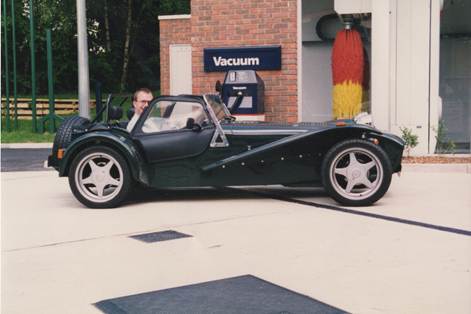
The 1.4-litre K-series Seven we hired in 1994. The standard chassis was a very tight fit.
The most unforgettable part of the visit was an unexpected passenger ride in Caterham’s HPC, fitted with the 2.0-litre, 16-valve Vauxhall engine. One of the Caterham sales team took us for what can only be described as a very spirited drive. The acceleration, the way the car seemed to fly around corners and the noise of the side-exit exhaust made it an astonishingly visceral experience. I was, frankly, scared half to death. Whether it was the speed itself or simply the sensation of being so exposed and close to the ground, I couldn’t say but . . . I retain vivid memories of the experience!!
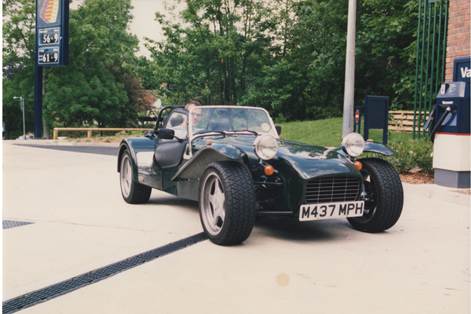
Another view of the same Seven on our 1994 outing.
That day probably did more than anything to convince me that I’d love to own a Caterham. Equally, it convinced me that the standard car was too small. Reluctantly, I put the idea aside, although it never entirely disappeared.
Thirty years later: a second chance
Unbeknown to me at the time, Caterham introduced the larger SV chassis in 2000. I eventually found out some years later and my interest was rekindled. It promised a little more room but I didn’t know whether it would really be enough. Eventually, in the winter of 2025 and somewhat on the spur of the moment, I visited Crazy Horse in Bury just to sit in an SV and find out.
To my surprise, I fitted. It was hardly spacious, of course – it’s still a Seven but it was perfectly adequate. After more than thirty years of assuming Caterham ownership wasn’t realistic, suddenly it was. Now retired and with the time to tackle a build, I decided that if I was ever going to do it, this was the moment.
Why a 360S SV?
I decided on a Caterham 360S SV self-build kit. My intention is to enjoy it on the road, mainly on dry summer days, not to take part in track days or chase lap times. The 2.0-litre Ford Duratec in the 360 seemed to offer the right blend of performance and usable mid-range power for the sort of driving I envisage. The higher-revving 420 has more peak power, but I doubt I’d spend enough time near the top of its rev range to make that worthwhile for me.
The S specification also felt like the natural choice: a more road-oriented set-up, with weather equipment and an open differential rather than some of the more track-focused features of the R. None of that means the car will be slow. My ride in the HPC all those years ago was a useful reminder that even a modestly powered Seven can feel extraordinarily quick!
I chose the traditional dark green paintwork with a yellow nose cone and a single yellow stripe down the bonnet. I also specified the removable steering wheel, an uprated brake master cylinder, a half hood and hood bag, and an external battery master switch so the car can be isolated during its winter lay-up.
Being tall influenced several of the other decisions. I wanted lowered floors so I would feel seated ‘in’ the car rather than perched on top of it. That inevitably makes ground clearance more of a concern, so I selected the dry-sump option, adjustable sports suspension and 15-inch wheels, the latter two in the hope of giving myself a little latitude when setting the car up and optimising ground clearance. I’ll need to establish the correct suspension settings rather than assume that winding on spring preload is an easy answer but at least it is something I can ‘play’ with.
My Caterham 360S SV – Factory Specification
My Caterham Seven 360S SV was ordered with a number of factory options which I selected to suit my intended use of the car. As the car will be used primarily for spirited road driving rather than track days, I wanted a specification that combined enjoyable handling, mechanical refinement and practicality.
The following table lists the factory options selected and their individual prices, excluding VAT. All these options are included in the original kit purchase price of £48,514.70 including VAT, rather than being additional expenditure.
| Factory Option | Price (inc VAT) |
|---|---|
| Dry Sump Lubrication System | £1860.00 |
| Sports Suspension Package | £960.00 |
| Uprated Brake Master Cylinder | £300.00 |
| 15-Inch Silver Orcus Alloy Wheels | £720.00 |
| Four-Point Race Harnesses | £300.00 |
| Battery Master Cut-Off Switch | £240.00 |
| Momo Leather Quick-Release Steering Wheel | £240.00 |
| Lowered Floors | £720.00 |
| Vintage Green Bodywork | Standard (No Cost Option) |
| Seven Grille In Detonator Yellow | £180.00 |
| Single Bonnet Stripe & Nose Cone in Detonator Yellow | £1500.00 |
| Gearbox & Handbrake Gaitors in Black Muirhead Leather | £300.00 |
| Dashoard Painted Vintage Green | £600.00 |
| Cam Cover Painted Vintage Green | £210.00 |
| Total Factory Options | £8130.00 |
Accessories Purchased Separately
| Accessory | Price (inc VAT) |
|---|---|
| SV Hood Bag | £193.57 |
| Half Hood (Without Zip) | £410.38 |
| Total Accessories | £603.95 |
Why I Chose These Options
When specifying my Caterham, I wanted a car that would be enjoyable to drive on the road rather than one optimised for track use. My intention is to enjoy spirited driving on country roads, with an emphasis on responsive handling, good mechanical feel and a usable spread of engine performance. I therefore selected a number of factory options that I felt would enhance the driving experience, while avoiding equipment that would offer little practical benefit for my intended use.
I chose the sports suspension package because I wanted to make the most of the car’s handling on winding country roads. The package includes wide-track front suspension, adjustable spring preload and a rear anti-roll bar. I felt these would be worthwhile additions to a car whose handling is such an important part of its appeal.
I also specified the dry sump lubrication system. Although I have no intention of using the car on track, the system is designed to provide additional protection against oil starvation during sustained cornering but also provides increased ground clearance under the engine. This reduces the risk of grounding on uneven surfaces or speed humps. Given the car’s relatively low ride height, I considered this a particularly worthwhile benefit for road use, despite the considerable additional cost.
I chose the 15-inch silver Orcus alloy wheels for two reasons: ground clearance and appearance. Of the wheel and tyre combinations offered by Caterham, the 15-inch option has a marginally larger overall rolling circumference, which provides a small increase in ground clearance. I appreciate that many Caterham owners favour the smaller 13-inch wheels for their handling characteristics but that wasn’t the deciding factor for me. I also think the larger wheels give the car a better overall appearance.
I specified the uprated brake master cylinder because I wanted a firmer, more positive brake pedal feel. Caterhams have unassisted brakes and although the uprated master cylinder may require slightly greater pedal effort, I felt that the improved firmness and more direct pedal response would suit my preference for a car with a more mechanical and involving driving experience.
At 6 ft 3 in tall, I was conscious that even in the larger SV chassis, cockpit space would be somewhat limited. I therefore specified lowered floors to improve the driving position, allowing me to sit further down inside the car rather than feeling as though I was sitting on it. Although the reduction in seat height is relatively modest, it makes a noticeable difference to the clearance between my legs and the steering wheel, as well as improving my sense of being comfortably accommodated within the cockpit. The disadvantage, of course, is that lowered floors reduce ground clearance beneath the car and this runs contrary to my efforts to improve it elsewhere. Nevertheless, I felt that the benefits to driving comfort and ergonomics justified this compromise.
I also purchased a half hood for the car, choosing the version without a zip. My main reason for wanting a half hood was to provide protection from strong sunlight during summer driving. Spending several hours in an open car on a sunny day can result in considerable exposure to the sun and I wanted the option of some shade without fitting a full hood. With the doors fitted, the half hood should also provide useful protection against light showers, although that was perhaps a secondary consideration.
I considered the zipped version, which would undoubtedly make getting in and out easier, particularly given my height, however, I was concerned about the long-term durability of a zip when in regular use. I therefore chose the simpler, less expensive option, accepting that entry and exit might be a little more awkward.
I specified four-point racing harnesses in preference to conventional seat belts, as I feel they better reflect the character of the car and contribute to a more purposeful driving experience. I also chose the Momo quick-release steering wheel, primarily because removing the wheel makes getting into and out of the relatively confined cockpit considerably easier. It also provides a useful additional deterrent against theft, as the car is rather less straightforward to drive away without its steering wheel!
The battery master cut-off switch was another practical addition. As I intend to use the Caterham mainly during the summer months, the car will probably spend much of the winter in storage. The switch allows me to isolate the battery easily during these periods, without having to disconnect the battery terminals. It also provides a further deterrent against theft.
For the paintwork, I chose Vintage Green for the bodywork and dashboard. I also specified a bonnet stripe, nose cone and Seven grille painted in Detonator Yellow. This is very much the traditional Lotus Seven colour scheme and one that I have always associated with the car. These days, Caterhams are available in all manner of bold and imaginative colour schemes but I am perhaps rather conventional in my tastes. I wanted the car to look like the archetypal Lotus Seven, even if that means sharing the same colour scheme with quite a few other owners!
A winter in the workshop
My kit arrived on 23 September 2026, and the plan is to begin the assembly in earnest in early December. It will be my winter project: something to get absorbed in during the months when I’m least likely to be biking or, eventually, driving the Caterham.
For me, building it is not merely a means to an end. I enjoy understanding how things go together, working carefully through practical problems and doing a job properly. After the abandoned Europa project, the Caterham feels like a much more manageable opportunity to build a vehicle of my own.
Whether I’ll enjoy driving the finished car quite as much as I expect remains to be seen. But more than thirty years after that unforgettable day in 1994, I’m very much looking forward to finding out.