With the Caterham safely unloaded and the initial inspection of the bodywork completed, the next job was to unpack the fourteen cardboard boxes and establish exactly what had been delivered.
Although I was keen to get started on the actual assembly, I thought it would be worthwhile spending some time organising everything first. With so many individual components, fixings and fittings involved, knowing where to find things should hopefully save a considerable amount of time later in the build.
Fourteen Boxes and a Collection of Loose Parts
The car had arrived with its full wet-weather hood fitted, and quite a few components had been stored inside the cockpit for transportation.
In addition to the fourteen cardboard boxes, a number of larger items were supplied loose. These included both seats, all four wheels, the front and rear mudguards, the nose cone, the exhaust and the catalytic converter.
Everything else was packed into the cardboard boxes.
The boxes themselves were generally labelled according to their contents, with descriptions such as Suspension, Axle and Lighting, Mechanical, Fluids, Interior, and Air Box and Cooling. Other boxes contained major components such as the gearbox, differential, rollover bar and radiator.
These labels provided a reasonable indication of what to expect inside each box, although the precise allocation of some individual components seemed a little arbitrary.
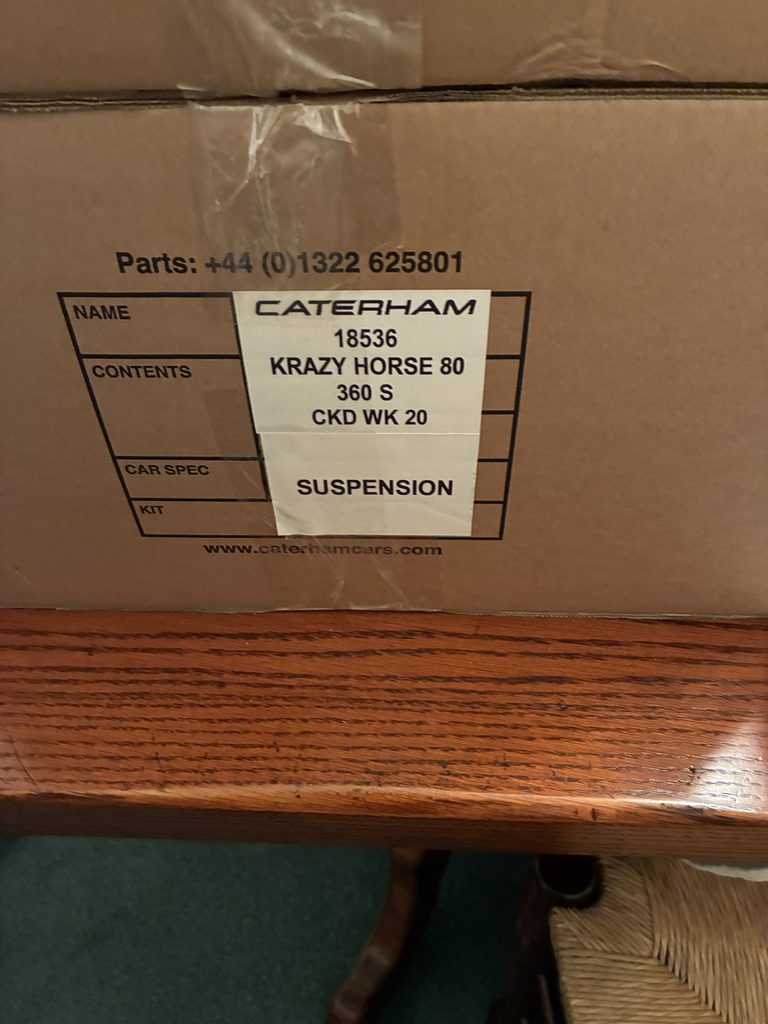
The original Caterham box labelling identifies the general area of the car for which the components are intended.
Unpacking and Labelling the Boxes
I decided to work through the boxes systematically, unpacking each one to identify its contents and then writing a more detailed description on the outside.
This seemed a sensible way of avoiding the inevitable search through fourteen boxes every time I needed a particular component.
Unfortunately, there was no comprehensive packing list supplied with the kit. Although I could identify and record what each box contained, I had no definitive list against which to check that everything had actually been delivered.
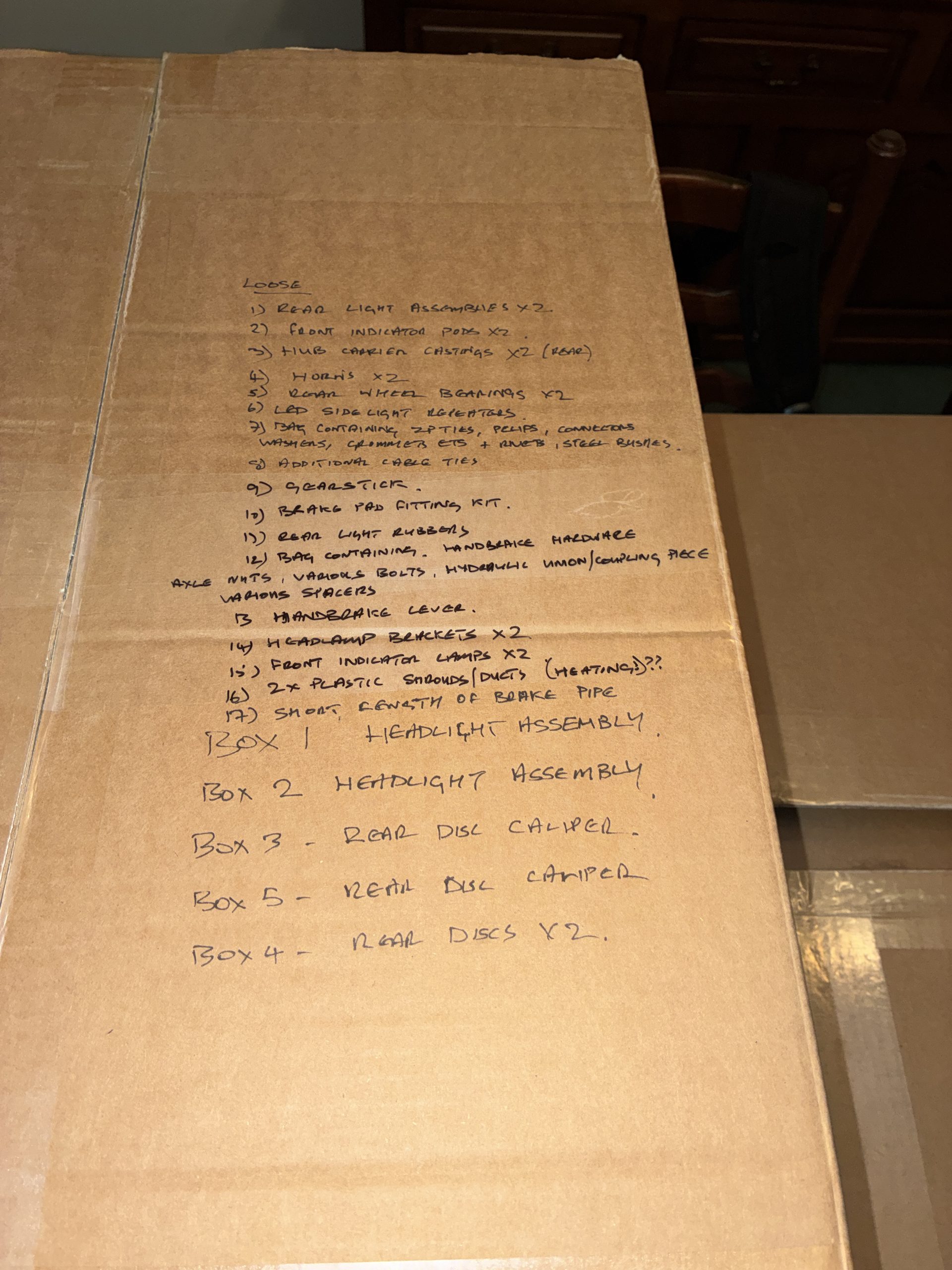
One example of the rather mixed approach to packing was the box labelled Axle and Lighting.
This contained several smaller boxes holding the headlight assemblies, rear brake calipers and rear brake discs. Also packed inside were the handbrake lever, horns and rear wheel bearings.
Alongside these recognisable components were less obvious items, including a loose bundle of eight cable ties and a separate bag containing assorted cable ties, P-clips, connectors, washers, grommets and other small fittings.
There was no accompanying list identifying the individual part numbers or explaining exactly where these miscellaneous items were intended to be used.
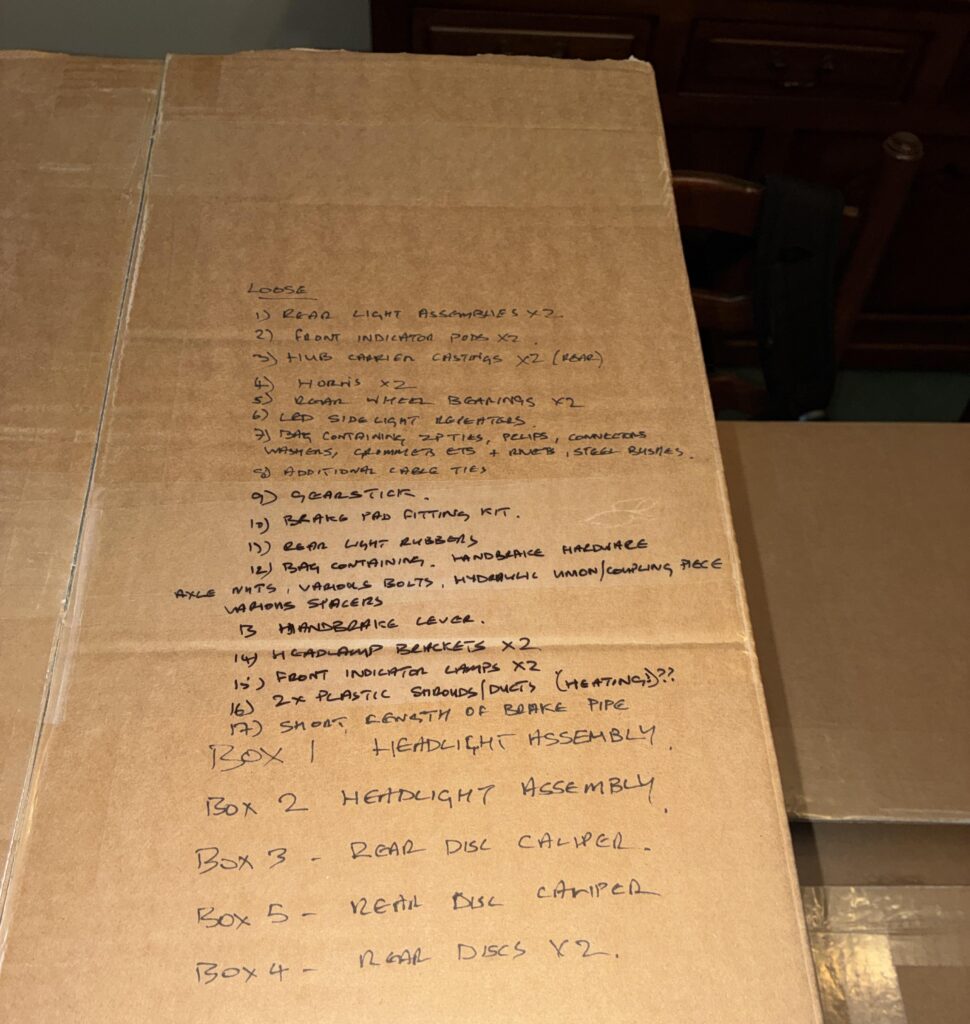
My own inventory, written on the outside of the box to make identifying and locating components easier.
The Individually Inventoried Fixing Kits
One box, however, was considerably easier to check.
The cardboard box was labelled Uprights and Z-packs, although somewhat confusingly, it contained no uprights at all. Instead, it contained fifteen sealed polythene bags, each accompanied by its own detailed inventory.
I don’t know whether Caterham officially refers to these bags as Z-packs or whether they had simply been placed in that particular box for convenience.
What was particularly helpful was that each inventory identified the individual components, their part numbers, the quantities supplied and where each item was intended to be used during assembly.
This made checking the contents relatively straightforward, and it was possible to carry out a proper inventory of all fifteen bags.
Remarkably, after checking the contents, there was only one genuine shortage.
Six No. 6 × ½-inch Pozidriv pan-head screws, identified as Caterham part number PD8, were missing.
I notified Caterham, and they dispatched the missing screws almost immediately. They arrived within a couple of days.
Considering the number of individual fixings involved, I thought that was a pretty good result.
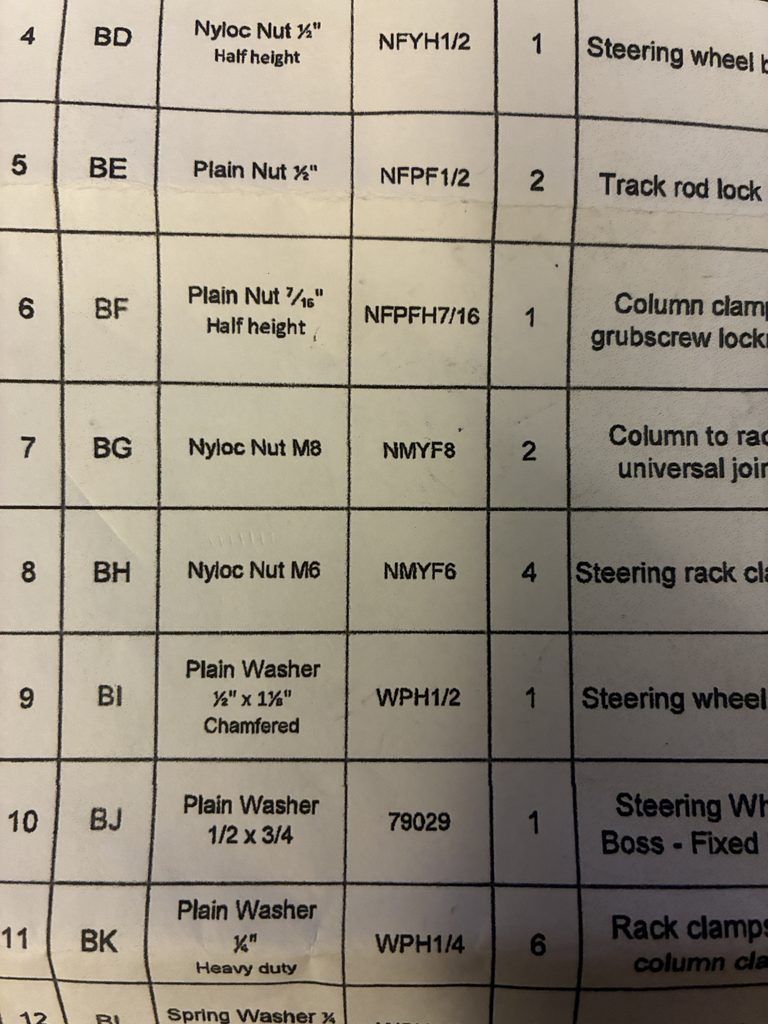
An example of Caterham’s detailed fixing-kit inventory, identifying part numbers, quantities and where individual components are used.
A Mystery Washer
There was one other apparent discrepancy.
While checking another fixing pack, I initially thought a washer was missing. However, I had previously put an unidentified washer to one side because I couldn’t match it to anything on the inventory.
It subsequently became apparent that Caterham had slightly changed the dimensions of the washer compared with the description on the packing list.
The supposedly missing washer had actually been there all along.
Unfortunately, I had already informed Caterham, who had arranged to send a replacement. So, although the replacement was unnecessary, it was another example of their prompt response to a reported shortage.
The Unidentified Miscellaneous Fittings
Unfortunately, the same level of documentation provided with the fifteen fixing kits was not present in many of the other cardboard boxes.
Some contained small bags of nuts, bolts, washers, rivets, cable ties, P-clips, grommets and assorted other fittings, but without individual part numbers, inventory sheets or labels explaining exactly where their contents were intended to be used.
In most cases, Caterham’s label on the outer box provided a broad indication of which area of the car the components belonged to. However, that didn’t necessarily make it obvious where every individual fitting should be installed.
The contrast with the fifteen individually documented fixing bags was quite striking. Those could be checked accurately and their contents allocated to particular stages of assembly, whereas some of the miscellaneous fittings in the other boxes were much more difficult to identify.
Some of these parts will undoubtedly become obvious as the build progresses. Others may be less straightforward, particularly where several similar-looking fixings could potentially be used in different locations.
Where there is any doubt, my intention is to photograph the unidentified components and contact Caterham Build Support for clarification rather than make assumptions.
Once their intended use has been established, I will label the individual bags accordingly.
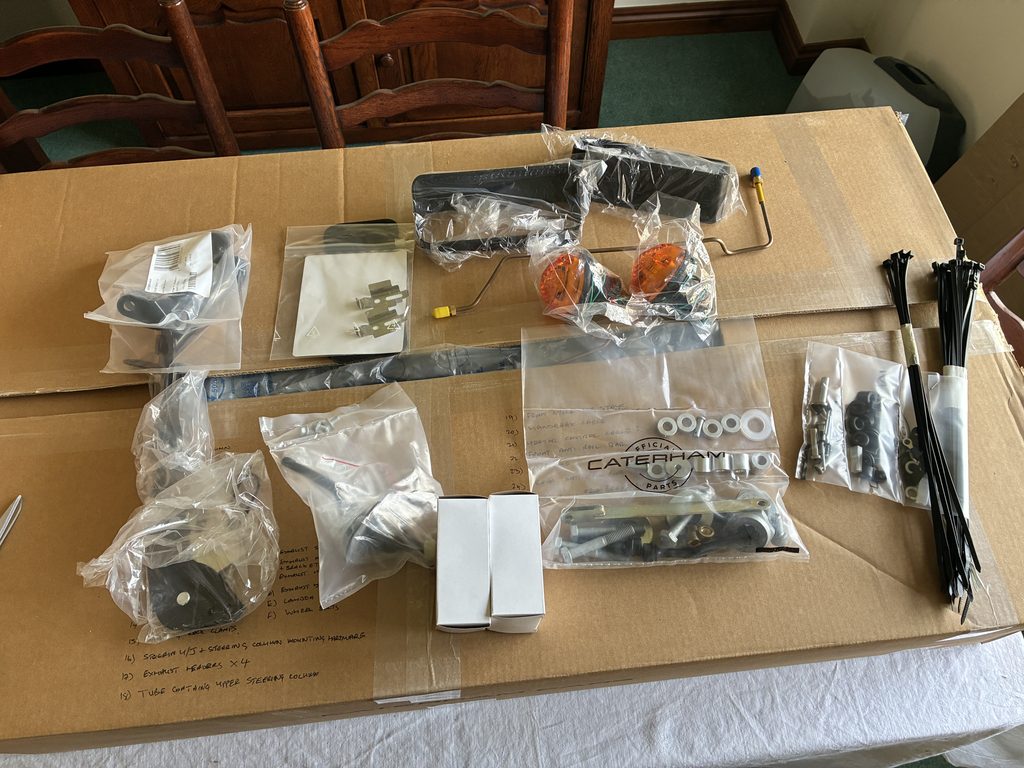
Some of the miscellaneous components and fittings unpacked from one of the larger boxes.
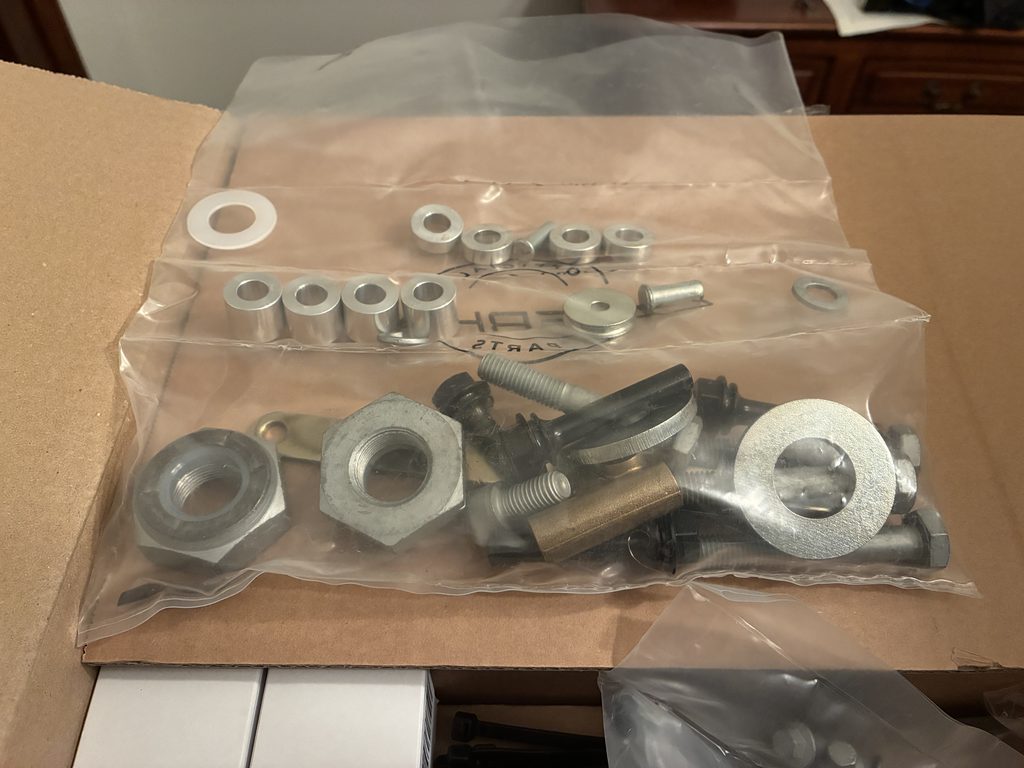
An assortment of unlabelled nuts, bolts, washers and spacers. Their intended application will probably become clear as the build proceeds.
Ready For Assembly
With the boxes unpacked and labelled, I now have a much better idea of what has been supplied and where everything is located.
However, without a comprehensive packing list for the complete kit, it isn’t really possible at this stage to establish whether every component has been delivered.
That may only become apparent as the assembly progresses.
For now, at least, all fourteen boxes have their contents written on the outside, and the fifteen individually inventoried fixing kits have been checked.
It may not be a perfect system, but it should make finding components considerably easier during the build.
I suspect that once I start following the assembly guide and fitting components to the chassis, some of the more mysterious bags of fixings will gradually begin to make sense. Where doubt still remains, I am sure I will be able to rely on the assistance of Caterham’s very helpful Builder Support Team.
Leave a Reply